Composition Notebooks for Precalculus: How to Choose
For Precalculus, choose a composition notebook that supports both graphs and worked equations. Start with the teacher’s math-journal requirement: some classes permit a lined or spiral notebook while others specify graph ruling.
The decision hinges on how often you graph function transformations, trigonometric relationships and other representations alongside written solutions.




Check the course requirement first
UT High School Precalculus A and B specify a math journal and allow a small composition notebook or spiral notebook. That is an example, not a rule for every AP Precalculus class. Check size, ruling, binding and sheet requirements separately from calculator requirements.
Balance function graphs with written algebra
Precalculus repeatedly connects function rules, domains, transformations, inverse functions and graphs. Trigonometry adds unit-circle diagrams, identities and periodic functions. Some courses include polar or parametric equations. Leave room beside a plotted function for steps explaining a shift, stretch or reflection. This is different from a Calculus notebook primarily organized around derivatives or integrals. For that later-stage workflow, see the Calculus composition notebook guide.
Lined versus graph ruling
College ruling suits dense symbolic steps and explanations; wide ruling leaves more space for larger writing. Graph ruling helps align axes, coordinate pairs and transformations, but can feel crowded for extended prose. For the broader grid decision, see the graph-ruled composition notebook guide. A combined lined/graph format or lined composition notebook with separately approved graph sheets may be preferable for mixed work.
Check 4×4 versus 5×5 and overall capacity
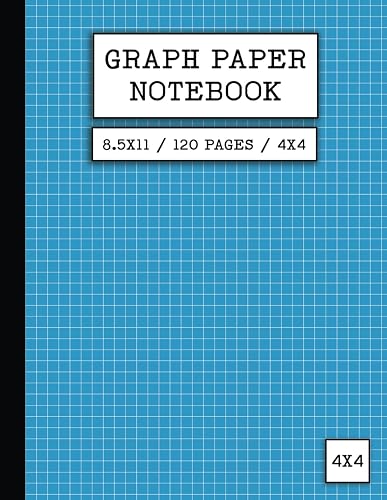
Four squares per inch provide larger drawing cells; five squares per inch provide a finer grid. If you need the denser option, compare the 5×5 quad-ruled guide. Do not assume every quadrille notebook has the same density. A typical full-size composition book is about 7.5 by 9.75 inches, but UT’s small math journal is a different requirement. Eighty sheets supply 160 writable sides and 100 sheets supply 200, if both sides are used.
Ten PurposeMatch configurations
Ten distinct scenarios, not rankings of particular products. Verify your specific course or local requirements.
- Small lined math journal. For a syllabus that permits compact journals and mostly written work.
- Full-size college-ruled. For long function calculations and written justifications.
- Wide-ruled notebook. For larger handwriting and spacious annotations.
- 4×4 graph-ruled. For large axes and transformation sketches.
- 5×5 graph-ruled. For denser coordinate plots.
- Combined lined and graph. For alternating worked equations and drawings.
- 80-sheet fixed binding. For a shorter course with preserved sequence.
- 100-sheet fixed binding. For extensive examples throughout a longer course.
- Flexible-cover composition. For portable coursework where permitted.
- Lined plus separate graph pad. For occasional graphs with teacher approval.
Use the pages as a function journal
For each example, show the original function, transformations, a labeled graph and a brief check or interpretation. For trigonometry, annotate periods, angle units and relevant intervals. Date and index related examples so the sequence of function families stays easy to review.
Avoid common mistakes
Do not assume graph paper is universally required or copy notebook advice from a Calculus course. Do not confuse paper sheet counts with writable sides. Do not replace a required composition book with spiral binding unless the syllabus permits it.
Frequently asked questions
Does Precalculus require graph paper?
Not universally. Check the instructor’s ruling requirement.
Is 4×4 or 5×5 better?
4×4 has larger cells; 5×5 supports more compact plotting.
Can I use a spiral notebook?
Only where permitted. UT High School accepts it as one math-journal option.
How does this differ from Calculus?
Precalculus emphasizes function families, transformations and trigonometric representations rather than primarily derivative and integral work.
RELATED POST
