How to Choose a Composition Notebook for Calculus
For calculus, a graph-ruled composition notebook can be a strong fit because the same page may need equations, multi-step derivations and sketches of functions. The best choice is not simply “graph paper,” though: grid density, page size, capacity and the course requirement determine whether the notebook feels useful or cramped.
Check the teacher’s supply list first, then choose the page system around how you actually solve and graph problems.




Follow the calculus course requirement first
Notebook requirements vary by school and instructor. A current 2026–27 US high-school supply list asks for graph composition books or graph-ruled notebooks for math classes and separately lists Calculus among the courses using graphing calculators. Other school lists have explicitly required a graph composition notebook for AP Calculus.
Those examples show that graph composition books are a real classroom format for higher mathematics, but they are not a universal rule. If your instructor specifies a binder, loose-leaf system or a particular notebook, use that requirement.
Why graph ruling can work well for calculus
Calculus alternates between symbolic work and visual interpretation. You may derive a result line by line and then sketch a function, tangent line, area or rate-of-change relationship next to the algebra.
A grid can make axes, scale, alignment and small diagrams easier to organize. The benefit is practical page geometry, not a claim that graph paper makes the subject easier.
Choose grid density around both graphs and handwriting
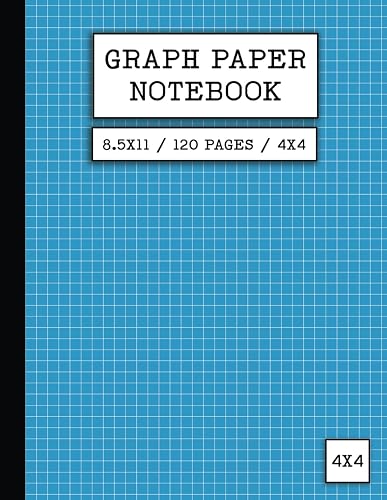
A coarser grid gives each square more room and can feel easier for larger handwriting or quick sketches. A denser grid fits more detail into the same page and can support compact plotting, but it may feel busy when long equations need to run horizontally.
Composition-Notebook.com already has separate 4×4 and 5×5 quad-ruled decision pages. For calculus, use those grid-density choices as tools: choose the one that keeps both graphs and algebra readable.
Long derivations make writing area important
Calculus problems often extend across several lines and may include substitutions, limits, derivative rules or integral steps. A page that is comfortable for short arithmetic can feel restrictive when each problem needs a full chain of reasoning.
Standard composition size remains portable, while larger formats create more horizontal and vertical working room. If your course allows different sizes, compare page area before choosing only by sheet count.
Capacity should match the course length
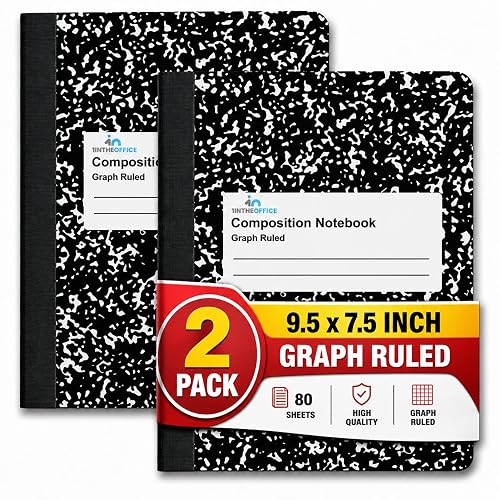
An 80-sheet graph composition book can be enough for a focused unit or a class that separates homework from notes. A 100-sheet book gives more continuity when lectures, examples and problem-solving stay in one volume.
Do not assume more sheets are always better. A thicker notebook adds bulk, and some students prefer one volume for class examples and another for practice.
PurposeMatch: ten calculus-ready configurations
These ten configurations represent different calculus workflows rather than ten cosmetic variants.
- 4×4 quad-ruled standard composition book: best for larger graph squares and readable hand-drawn axes.
- 5×5 quad-ruled standard composition book: useful for denser plotting and compact technical work.
- 80-sheet graph composition book: balanced for students who value lower bulk.
- 100-sheet graph composition book: useful when one notebook must hold a long sequence of examples and notes.
- Large or Letter-size graph composition format: gives long derivations more horizontal room when the course permits a larger book.
- A4 graph composition format: useful when extra page area is more important than US-standard portability.
- B5 graph format: a middle-size option when available and clearly specified by the seller.
- Lay-flat graph notebook: useful when the book stays open beside a textbook or calculator for extended problem solving.
- Durable poly-cover graph composition book: useful for daily transport when cover resilience matters.
- Lined composition book plus separate graph paper: a valid alternative when the instructor allows it and prose-heavy notes outweigh graphing frequency.
Fixed binding can help keep worked examples in sequence
A composition-style fixed binding keeps pages in order. That can be useful when later problems build on earlier examples and you want a continuous record of methods and corrections.
If your class requires tear-out homework, however, a separate loose-leaf or perforated system may be more practical for submitted work. Do not force one notebook to solve every class task.
When lined pages may still be the better choice
Not every calculus course uses the notebook primarily for graphing. If the instructor supplies printed graphs, uses digital graphing tools extensively or asks for mostly written notes, a college-ruled composition book plus separate graph paper can work well.
The decision is frequency: if you draw graphs on many pages, a grid is convenient. If graphing is occasional, lined pages may give cleaner space for written explanations and long equations.
Mistakes to avoid
The word “calculus” does not create one universal notebook specification.
- Do not ignore the teacher’s required format.
- Do not choose the densest grid automatically.
- Do not overlook horizontal writing space for long derivations.
- Do not buy maximum capacity if the notebook must stay light.
- Do not confuse a graphing-calculator requirement with a requirement for graph paper.
Frequently asked questions
These questions focus on the page-layout choices that matter most for calculus.
Is a graph composition notebook good for calculus?
It can be, especially when you regularly sketch functions, axes and visual relationships alongside equations. Follow the course requirement first.
Is 4×4 or 5×5 graph ruling better for calculus?
Neither is universally better. A 4×4 grid gives larger squares, while 5×5 provides denser plotting space. Choose the density that keeps both graphs and handwriting readable.
How many sheets should a calculus notebook have?
It depends on whether the notebook holds lectures, worked examples and homework in one place. An 80-sheet book can reduce bulk; 100 sheets provides more continuity.
Can I use a lined composition notebook for calculus?
Yes when the instructor allows it. Lined pages can work well if graphing is occasional and you use separate graph paper or digital tools for plots.
RELATED POST
