Composition Notebooks for Forensic Science Class
Forensic science students should choose a composition book around the instructor’s lab and activity requirements. Prioritize dated observations, sketches and tables, sufficient capacity and reliable page retention—not a crime-themed design. A school notebook is not a professional evidence log.


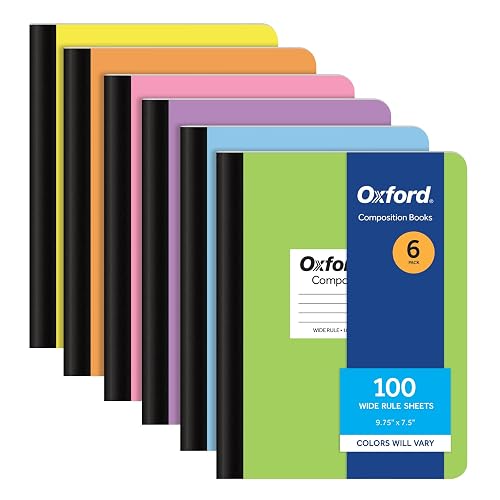

Check how the teacher uses the notebook
A forensic science syllabus explicitly specifies a composition notebook for labs, while Clinton Community College requires a composition notebook for its forensic laboratory classes. In another classroom, the same notebook may serve for lecture notes or graded activities. Ask whether entries must remain bound, whether the book is collected and whether graphs or drawings are expected. For the broader subject context, see the science composition notebook guide.
Organize observations without confusing them with conclusions
A useful classroom entry starts with the date, activity and objective, followed by recorded observations, a table or labeled sketch, then a separately identified interpretation. Some students add numbered pages and a contents list. This improves retrieval but is not chain-of-custody documentation or legal certification. If indexing is central, compare the numbered-page composition notebook guide.
Choose lined or graph ruling for the dominant task
College ruling supports compact written observations. Wide ruling gives bigger handwriting and captions more room. Graph ruling helps when repeated tables, scale sketches or plotted measurements need alignment. A lined notebook and separate teacher-approved graph sheets may work better for a prose-heavy class.
Page retention, capacity and cover construction
Non-perforated pages can support continuous class records when removal is discouraged; perforated pages are useful only if the instructor permits submission by tear-out. Perforation and binding must be checked separately. Eighty sheets mean up to 160 writable sides, versus 200 for 100 sheets, if both sides are used. For the physical format distinction read the perforated-page guide.
Ten classroom forensic notebook configurations
These are ten distinct buying configurations, not a ranking of specific products. Confirm actual specifications before purchasing.
- Non-perforated college ruled: Compact chronological lab observations; no planned tear-outs.
- Non-perforated wide ruled: Larger handwriting and explanatory diagrams; fewer lines.
- Graph ruled: Frequent measurements and tables; more visual grid than prose needs.
- 80-sheet bound notebook: Short modules and modest activity loads; monitor capacity.
- 100-sheet bound notebook: Long courses with repeated experiments; bulkier book.
- Numbered-page setup: Easy indexing of activities; printed numbers not always provided.
- Stiff cover: Steady drawing or writing on shared classroom benches; more weight.
- Poly cover: Repeated carrying; does not imply waterproof notes.
- Lined pages with sketch spaces: Mostly explanations plus occasional diagrams; plan room for captions.
- Teacher-approved perforated pages: Individual activity sheets handed in; not suitable where intact records are required.
What an ordinary composition notebook cannot do
A school composition book does not, by itself, document custody, establish an official evidence trail or satisfy professional forensic protocols. Do not use it for those claims. Also avoid buying a format based only on cover art, tearing out lab entries without permission or assuming every forensic course needs graph paper.
Simple routine for class activities
Label the notebook as instructed. Date every activity, keep original classroom observations distinct from later interpretations, write measurement units with data, caption sketches and record enough context to understand each page when reviewing the unit.
Frequently asked questions
Must forensic class notebooks be non-perforated?
Not always. Follow the instructor’s rules about retained entries and collected pages.
Should the pages be graph ruled?
Only when data and plotting demands justify it or the instructor specifies graph paper.
Can a regular composition book serve as an official evidence log?
No. Classroom stationery is not a legal or professional chain-of-custody system.
Do page numbers matter?
They can make course activities easier to find; follow any required notebook layout.
RELATED POST
