Junior Composition Notebooks: How to Choose the Right Compact Format
A junior composition notebook is a compact school-style book, commonly around 5 by 7.5 inches, that preserves more usable writing height than a tiny pocket notebook. The label does not guarantee one ruling, capacity or binding.
Choose it when smaller page width is helpful, then verify the exact specifications rather than buying by the word “junior” alone.




Quick decision
Junior size is most useful when a standard composition book feels unnecessarily wide but a true mini book would make sustained writing cramped.
- Choose junior size for vocabulary, daily language practice, short exercises or portable reference notes.
- Choose standard size when worksheets, long paragraphs, diagrams or full-page class notes need more width.
- Choose a true mini when pocketability matters more than comfortable multi-line writing.
What “junior” currently means
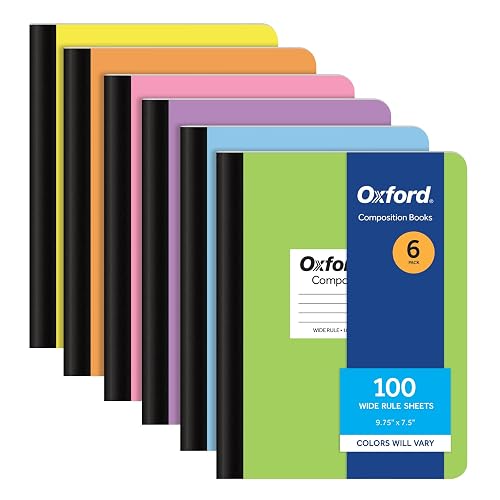
Current physical catalogs show a recognizable but not perfectly standardized compact category. Pacon lists a junior composition book at 5 by 7.5 inches with 100 sheets and 3/8-inch ruling. Oxford listings use approximately 4.88 by 7.5 inches with 80 sheets. A Kokuyo half-size junior model is about 5 by 7 inches with 30 sheets and 6 mm dotted ruling.
These are materially different configurations. The common idea is a narrower, shorter footprint than the familiar 7.5 by 9.75-inch book—not one universal specification.
Junior is not simply another word for mini
A mini composition notebook can be small enough for a pocket, quick lists or brief reminders. A junior model usually offers a taller page and a more classroom-oriented ruling, making repeated sentences and exercises easier to manage.
Compare dimensions numerically. Retailers may use junior, half-size, small and mini inconsistently, so the product name alone cannot settle the choice.
Compare junior size with the standard format
The familiar 7.5 by 9.75-inch composition notebook provides substantially more line length and page area. That helps with lecture notes, tables, pasted materials and extended writing.
Junior pages reduce bag, desk and storage footprint. The trade-off is earlier line wrapping and less room for wide diagrams. Use the site’s composition notebook size guide when portability and writing area are still evenly balanced.
Choose ruling from the handwriting task
Junior does not define line spacing. Pacon’s current model uses 3/8-inch ruling, Oxford junior books are sold as wide ruled, and Kokuyo’s compact model uses 6 mm dotted ruling. Those layouts suit different writers.
- Choose wider spacing for developing handwriting, larger letterforms or short practice entries.
- Choose closer spacing for compact adult handwriting and dense portable notes.
- Choose dotted or segmented guides only when their visual structure supports the intended exercise.
For larger handwriting, the wide-ruled composition notebook guide explains the ruling decision independently of size.
For early writers, follow the page requirement
A smaller page can feel achievable because each exercise occupies a meaningful portion of the sheet. Pacon positions its junior book for young students and current education retailers describe uses such as grammar, vocabulary and journaling.
That does not replace a teacher’s requirement for primary ruling, dashed midlines or picture space. The kindergarten composition notebook guide covers those early-writing layout choices.
Capacity changes the carrying trade-off
Compact size does not always mean low capacity. Current junior examples range from 30 sheets to 80 or 100 sheets. A 100-sheet junior book can last longer but will be thicker than a short exercise book.
Check whether the retailer states sheets or pages. One sheet normally has two writable sides, but listings do not always use the terms consistently. Do not convert the number unless the source makes the relationship explicit.
Binding controls retention and opening
Pacon and Oxford junior products use fixed book-style construction, while compact products from other markets may use different bindings. Choose sewn or otherwise fixed pages when the notebook must preserve a chronological record.
Verify the exact model if flat opening, easy removal or page replacement matters. The junior label describes market position more than binding engineering.
Check pack quantity before comparing value
Junior composition books are commonly sold as classroom packs as well as individual books. Pacon and Oxford listings may bundle six or twelve books, while some marketplace results describe a single retail unit.
Compare cost per usable book only after confirming quantity, sheet count and ruling. A low displayed price can refer to one book; a large total can represent a full classroom case.
Best uses for the compact page
The format works well when entries are short and repeated rather than wide and diagram-heavy. Examples include vocabulary, spelling practice, reading logs, field observations, language drills, recipes or portable project notes.
For long-form essays, complex math or full-size handouts, the reduced width may create more friction than portability saves.
Run a writing-area test
Mark out a rectangle matching the published dimensions. Write one normal heading and five lines, then add the widest diagram or table you expect to use. This exposes line wrapping and margin pressure before you buy a pack.
Buying checklist
Use the product specification, not the category label, to complete the decision.
- Exact width and height
- Line spacing or ruling type
- Sheets versus pages
- Binding and page retention
- Cover construction
- Single book, pack or case quantity
- Teacher or course requirement
What to avoid
Most mistakes come from assuming every compact composition book is built for the same user.
- Do not treat junior, mini and pocket as exact synonyms.
- Do not assume all junior books measure 5 by 7.5 inches.
- Do not infer ruling from the age recommendation.
- Do not mistake 100 sheets for 100 writable sides.
- Do not buy a classroom pack when you need one book.
Frequently asked questions
These answers clarify what “junior” means and which specifications still need checking.
What size is a junior composition notebook?
Many current junior models are about 5 by 7.5 inches, but the label is not a universal size standard. Verify the dimensions on the exact product.
Is a junior composition notebook the same as a mini composition book?
No. A junior book is often tall enough for school exercises while being narrower than a standard composition book. Mini and pocket models can be much smaller.
Is junior ruling always wide ruled?
No. Current products include 3/8-inch ruling, wide ruling and narrower dotted ruling. Check spacing rather than trusting the word junior.
Are junior composition books only for children?
No. Their compact footprint can also suit vocabulary lists, field notes and portable reference work, provided the ruling and writing area fit the user.
RELATED POST
