Oversized Composition Notebooks: When Extra Page Area Helps
An oversized composition notebook is useful when extra writing area solves a real problem, but “oversized” is not a universal paper standard. Current products can sit between the familiar composition-book footprint and full US Letter size.
Verify the dimensions first, then choose ruling, cover, capacity and binding.




What oversized means in the current catalog
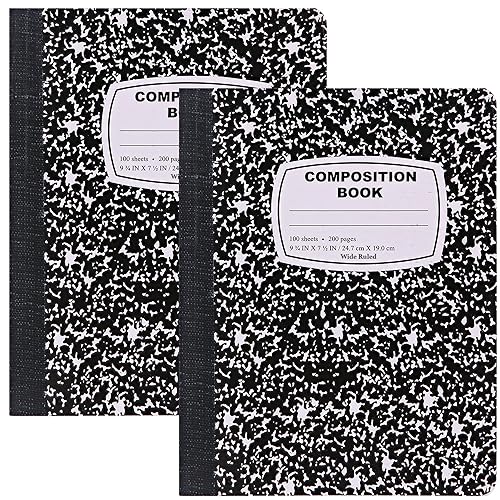
Roaring Spring currently identifies several 10.25 by 7.88-inch composition books as oversized. That footprint is larger than the common 9.75 by 7.5-inch format while remaining smaller than 11 by 8.5-inch US Letter.
Other sellers may use large, extra large or oversized more loosely. Treat the adjective as a search clue, not as a measurement.
Compare it with standard and letter-size formats
A standard 7.5 by 9.75 composition notebook is easier to fit into familiar school bags and narrow desks. The 10.25 by 7.88-inch example adds height and width without using the full footprint of a letter-size book.
A true 8.5 by 11-inch format creates more room for worksheets and broad diagrams. The large composition notebook guide covers that decision separately.
Choose extra area for a specific job
- Choose oversized when standard pages make diagrams, equations or long lines feel cramped.
- Stay standard when portability and desk fit matter more than extra area.
- Move to letter size when matching full-size handouts is the priority.
More space only helps if your layouts use it. A larger blank border around short notes adds carrying bulk without improving the work.
Ruling changes how the extra area works
The current oversized range includes college-ruled, wide-ruled, unruled and 5×5 grid-ruled configurations.
- College ruling supports dense text notes.
- Wide ruling creates more vertical room for larger handwriting.
- Unruled pages suit sketches and free layouts.
- 5×5 grid ruling supports calculations, tables and aligned diagrams.
Choose the page pattern before cover design. The larger footprint cannot correct an unsuitable ruling.
Hard and flexible covers serve different settings
Current hard-cover examples use heavy board and provide a firmer writing surface. Flexible-cover oversized models reduce stiffness and may pack more easily.
Choose hard board when you write away from a desk or need edge protection. Choose a flexible cover when bag space and lower bulk matter more. The size and cover decisions should be evaluated together.
Capacity must be verified separately
Current Signature Collection hard-cover examples list 80 sheets and 160 pages. That does not establish a universal capacity for all oversized books.
Keep sheets and pages separate when comparing listings. A sheet has two writable sides, but retailers may use the terms inconsistently. Match capacity to the duration of the class or project rather than selecting the largest number automatically.
Binding affects retention and gutter use
The sourced hard-cover models use center-sewn and tape-bound construction, with pages not intended for tear-out. That supports chronological records but is less convenient when work must be submitted as loose sheets.
Verify binding on the exact item. Oversized describes footprint, not whether pages are fixed, perforated or removable.
Check portability before buying
Measure the bag compartment and the usable desk surface. An intermediate-size book may fit where letter size does not, but it still consumes more space than a standard composition book.
The composition notebook size guide helps compare the broader format family.
Quick selector
- Need slightly more room without full letter size: verify an intermediate oversized model.
- Need maximum compatibility with classroom desks and bags: stay near standard size.
- Need full-size worksheet alignment: consider letter size.
- Need visual freedom: choose unruled.
- Need measured layouts: choose 5×5 grid.
- Need a firm portable surface: choose hard cover.
Buying checklist
- Exact width and height
- Ruling and grid density
- Sheets versus pages
- Cover construction
- Binding and page retention
- Paper weight when stated
- Single book, pack or case quantity
What to avoid
- Do not assume oversized means 8.5 by 11 inches.
- Do not infer ruling from the cover.
- Do not assume all oversized models have 80 sheets.
- Do not buy a case when you need one book.
- Do not ignore bag and desk measurements.
For current brand configurations, the Roaring Spring composition notebook guide connects oversized models with the rest of the range.
Frequently asked questions
These answers clarify the size label and the choices that remain after it.
What size is an oversized composition notebook?
There is no universal oversized standard. One current Roaring Spring range uses 10.25 by 7.88 inches, but buyers should verify the exact product dimensions.
Is an oversized composition notebook the same as letter size?
No. A 10.25 by 7.88-inch model is smaller in both dimensions than 11 by 8.5-inch US Letter. Other brands may use the oversized label differently.
Which rulings are available?
Current physical catalogs include college-ruled, wide-ruled, unruled and 5×5 grid-ruled oversized composition books.
Is an oversized book harder to carry?
It occupies more bag and desk space than a traditional 7.5 by 9.75-inch composition book. Cover stiffness and sheet count also affect carrying bulk.
RELATED POST
