4×4 Quad-Ruled Composition Notebooks: When Larger Squares Help
A 4×4 quad-ruled composition notebook uses four grid squares per inch, giving each square about 0.25 inch of width and height. That larger cell can be useful when you want more room for handwriting, diagrams or calculations than a denser 5×5 grid provides.
The grid is only one specification. Check the notebook size, sheet count, binding and whether the exact product really uses four squares per inch before buying.


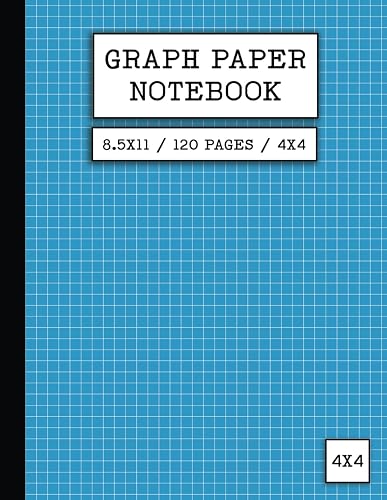
What 4×4 quad ruling actually means
In this context, 4×4 means four squares per inch. Dividing one inch into four equal cells gives a grid spacing of approximately 0.25 inch. BAZIC currently specifies this format on a 100-sheet, 9.75 x 7.5 inch casebound composition book, while Enday lists a sewn hard-cover graph composition notebook with the same four-squares-per-inch density.
4×4 versus 5×5: choose the cell size first
A 5×5 grid fits five squares into each inch, so its cells are smaller than those on a 4×4 page. The denser grid gives you more divisions for plotting or compact calculations. A 4×4 grid gives each entry, symbol or sketch more room.
Neither density is automatically better. The useful choice depends on how small you write, how much precision the work needs and whether diagrams benefit from larger cells.
When larger grid squares help
Four-squares-per-inch ruling can be practical for students who write larger numbers or labels, for diagrams that need visible annotations, and for work where a very dense grid adds visual clutter. If a teacher or course specifies a particular grid density, that requirement should override personal preference.
When a denser grid may be better
Choose 5×5 or another denser grid when you need more plotting divisions across the same page or prefer compact mathematical work. Some current composition notebooks are reversible, with 4×4 ruling on one side and 5×5 on the other, which can be useful when both densities have a role in the same class or project.
Page size changes how much grid you get
Grid density and notebook dimensions are separate decisions. A standard-size 4×4 composition book and a letter-size graph notebook can have the same number of squares per inch but very different total working areas. Compare physical dimensions before assuming two 4×4 books provide the same layout.
Check capacity and binding separately
BAZIC’s verified 4×4 composition book uses 100 sheets and sewn-in casebound pages. Other products vary. Grid density does not tell you whether pages are sewn, tape-bound, perforated or removable, so verify those features on the exact listing if page retention matters.
A practical buying checklist
- Confirm that 4×4 means four squares per inch.
- Compare the cell size with 5×5 before choosing.
- Check the physical page dimensions.
- Verify sheet count rather than estimating capacity from thickness.
- Check binding and perforation separately from ruling.
- Follow any teacher or course specification exactly.
Frequently asked questions
What does 4×4 quad ruled mean?
It means the page has four grid squares per inch, so each square is approximately 0.25 inch.
Is 4×4 graph paper larger than 5×5?
The notebook itself is not necessarily larger, but each grid cell is larger because fewer squares fit into one inch.
Is 4×4 better for math?
Not universally. Larger cells can help with bigger handwriting and diagrams, while a denser grid can provide more plotting divisions. Follow the course requirement when one is specified.
Are all 4×4 composition notebooks permanently bound?
No. Grid density does not determine binding or perforation. Check those specifications on the exact product.
RELATED POST
