20 lb Paper Composition Notebooks: What the Weight Specification Means
A 20 lb paper label describes the paper stock, not the total weight of a composition notebook. It can help narrow the catalog, but it does not decide ruling, dimensions, capacity, binding or ink behavior.
Use it as one specification in a complete buying decision.


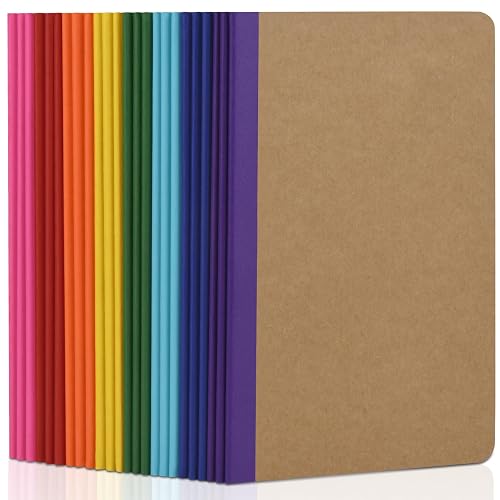
What 20 lb paper means
In US product listings, 20 lb is a basis-weight label. Basis weight is tied to the weight of a standard quantity of a defined parent sheet, so the number is not the weight of one sheet or the finished notebook.
That makes the label useful for comparing clearly specified products within the same paper category. It is not enough to predict every physical or writing property on its own.
Do not treat 20 lb and GSM as interchangeable labels
GSM expresses grams per square metre. Basis-weight systems use category-specific reference sheet sizes, so an unsourced one-number conversion can mislead.
A current Roaring Spring product listing pairs 20 lb basis weight with 75 g/m² for one oversized college-ruled model. Treat that as an exact-product specification, not a universal rule. For a direct grammage-focused explanation, use the 80 GSM composition notebook guide.
Choose the ruling independently
Current 20 lb listings include college-ruled, unruled and 5×5 grid-ruled composition books. The same weight label can therefore serve very different work.
- Choose college ruled for compact handwriting and dense notes.
- Choose 5×5 grid for calculations, aligned diagrams and tables.
- Choose unruled for sketches, maps and unrestricted layouts.
Paper weight cannot compensate for the wrong page pattern.
Compare dimensions and writing area
Staples currently describes one Studio Series model as 9.75 by 7.5 inches. Roaring Spring also lists oversized 20 lb hard-cover configurations, and one retailer specifies an oversized college-ruled model at 10.25 by 7.88 inches.
Choose the smaller footprint for familiar portability. Choose an oversized book when extra writing area matters and your bag and desk can accommodate it. Verify measurements on the exact listing.
Capacity is a separate decision
The current Studio Series example has 70 sheets and 140 pages. The sourced oversized Signature Collection example has 80 sheets and 160 pages.
A sheet has two sides, but retailers do not always use sheets and pages consistently. If a course specifies a capacity, compare the same unit and consult the 100-sheet composition notebook guide when that requirement is explicit.
Binding changes retention and opening behavior
The sourced 20 lb models use fixed binding, but construction still varies. Staples describes its Studio Series book as center-sewn with tape binding; the oversized Roaring Spring listing is sewn and tape-bound with sheets not designed for tear-out.
Choose permanent binding for chronological notes and records. If pages must be submitted, a fixed-bound book may be the wrong system regardless of paper weight.
Paper weight does not prove pen compatibility
A heavier-sounding label can suggest a more substantial sheet, but bleed-through, feathering, show-through and drying also depend on paper finish, sizing, opacity and the ink itself.
When liquid ink matters, apply the tests in the fountain-pen-friendly composition notebook guide. Test a back page before committing an important project.
Quick selector
- Choose 20 lb only when the listing states it for the exact composition book.
- Choose ruling from the writing or drawing task.
- Choose dimensions from available workspace and portability.
- Choose capacity from the expected project length.
- Choose binding from page-retention or removal needs.
- Verify ink performance separately.
Buying checklist
Read the detailed specification rather than relying on the search-result title.
- Is 20 lb stated for the inside paper?
- What ruling is printed?
- What are the exact dimensions?
- Is capacity stated in sheets, pages or both?
- How is the book bound?
- Is paper performance supported for your pen?
- Is the listing a single book, pack or case?
What to avoid
- Do not interpret 20 lb as the finished notebook’s weight.
- Do not apply one GSM conversion to every paper category.
- Do not assume 20 lb determines ruling or capacity.
- Do not promise zero bleed-through without product-specific evidence.
- Do not confuse printer paper results with composition notebooks.
Roaring Spring currently supplies several relevant configurations; the Roaring Spring composition notebook guide places them in the wider brand range.
Frequently asked questions
These answers clarify what the 20 lb specification does and does not tell you.
Does 20 lb describe the weight of the notebook?
No. It is a basis-weight description of the paper, not the total weight of the bound book.
Is 20 lb paper always 75 gsm?
No universal conversion should be assumed from the label alone. One current Roaring Spring listing pairs 20 lb with 75 g/m² for that exact model; verify the manufacturer specification for the item you are considering.
Does 20 lb paper prevent bleed-through?
Not automatically. Ink behavior also depends on finish, sizing, opacity, ink and nib. Use a product-specific test when pen performance matters.
Are all 20 lb composition books college ruled?
No. Current catalogs include college-ruled, unruled and 5×5 grid-ruled 20 lb configurations.
RELATED POST
