How to Choose a Composition Notebook for Physics
For physics, the course requirement should choose the notebook before generic advice does. Current 2026-2027 requirements range from ordinary composition books with college lining preferred to bound quadrille composition notebooks used separately for notes and labs.
First identify whether the book is for class notes, problem solving or a lab record; then choose ruling, capacity, binding and cover.




Start with the physics course requirement
Current requirements vary. North Linn High School’s 2026-2027 list asks Physical Science, Chemistry and Physics students for a one-subject composition notebook, with college lining preferred. St. Anne-Pacelli requires a composition book for CP Physics and Physics Honors. Current Amarillo College physics syllabi require two bound quadrille composition notebooks and explicitly reject spirals.
These are course-specific examples, not universal standards. Follow the actual teacher or syllabus first.
Decide whether the book is for notes or a lab record
A general physics composition notebook may hold definitions, worked problems and class notes. A lab notebook has a narrower record-keeping role. Amarillo’s current physics requirements separate the two, assigning one bound quadrille composition notebook to labs and another to notes.
Do not assume one book can serve both roles when the course explicitly separates them.
Lined pages can be right for text-heavy physics notes
Physics is quantitative, but not every page is a graph. North Linn currently prefers college lining for its physics-related composition notebook, showing that lined pages can fit notes, equations and explanations when the course is organized that way.
If ruling is open, college ruling suits compact dense notes; wider ruling gives larger handwriting and annotations more vertical room.
Graph or quad ruling helps when alignment is frequent
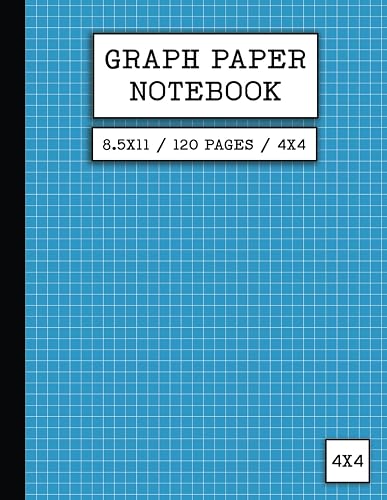
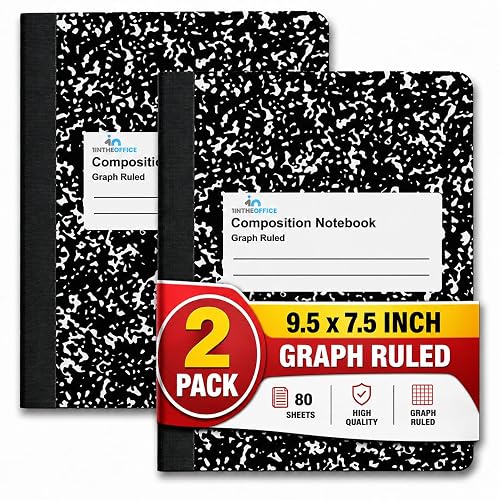
A grid can make plots, tables, vector sketches and multi-step calculations easier to align. Current Staples graph composition books use five squares per inch, while current Enday products include four-squares-per-inch quad formats. The exact grid therefore matters when a course specifies one.
Do not buy graph paper merely because the subject is physics. Use it when the teacher requires it or the recurring work benefits from alignment.
Bound pages can matter for lab continuity
Some physics courses explicitly require bound composition books and reject spirals. Fixed pages keep observations, calculations and corrections in sequence, which can be useful when the notebook is treated as a continuing lab record.
If the course does not impose a binding rule, fixed pages are a workflow choice rather than a universal physics requirement.
Capacity should match the role of the notebook
A long-running class or lab record may benefit from higher capacity, while separate books for notes and labs can reduce the need for one very thick volume. Current graph composition products include 80- and 100-sheet examples.
Check whether a listing counts physical sheets or writable page sides before comparing capacity.
Cover construction comes after the page requirement
Current graph composition books include rigid casebound and other cover constructions. A rigid cover can provide a firmer writing surface, while flexible covers can reduce bulk. Cover type does not determine grid density or paper performance.
Do not confuse a composition notebook with lab-grade equipment
An ordinary composition notebook is not automatically chemical-resistant, waterproof or compliant with every laboratory record standard. Use it for lab work only when the course permits that format and follow all separate safety and record-keeping instructions.
What to avoid
The main mistake is turning Physics into one universal notebook specification.
- Do not assume every physics class requires graph ruling.
- Do not assume every physics class requires a composition notebook.
- Do not substitute a spiral notebook when a bound composition book is required.
- Do not assume every graph composition book uses the same grid density.
- Do not call an ordinary composition book lab-grade without evidence.
Frequently asked questions
These questions cover the choices left open by a physics course.
Does physics need a graph composition notebook?
Not universally. A grid helps with repeated plotting and alignment, but some current physics courses prefer ordinary lined composition books.
Should a physics composition notebook be college ruled?
Only when the course requires or prefers it, or when compact handwriting and dense notes benefit from tighter ruling.
Can a regular composition notebook be used as a physics lab notebook?
Only when the course permits it. Some current physics courses explicitly require bound quadrille composition notebooks for lab records.
How many composition notebooks are needed for physics?
There is no universal number. Some courses require one book, while others separate notes and lab work into two bound composition notebooks.
RELATED POST
