Composition Notebooks for Middle School: Follow the Class List First
For middle school, the correct composition notebook is the one the class actually asks for. Current 2026–2027 supply lists show composition books being required for science, ELA, social studies, Spanish and math, with quantity and ruling varying by school and course.
Check the supply list first; use general ruling and durability advice only when the requirement leaves those choices open.


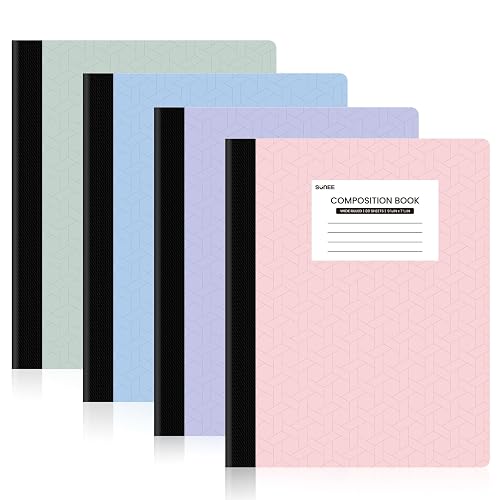
There is no universal middle-school composition notebook
Fresh 2026–2027 lists demonstrate real variation. Athens Middle School requires a composition notebook for sixth-grade science. Central Academy lists one for sixth-grade science. Valley Central specifies different quantities by grade, while Bailey Middle includes subject-specific requirements and explicitly calls for a college-ruled composition notebook in math.
These are local requirements, not national standards. Their value is showing why age alone cannot choose the notebook.
Start with the school, team or teacher list
A supply list may specify quantity, ruling, color, page count or subject. When it does, follow those details before applying generic buying advice.
If a list simply says “composition notebook,” then handwriting, subject work and durability become useful secondary filters.
Wide versus college ruling depends on handwriting and note density
Wide ruling gives larger handwriting more vertical room. College ruling fits more lines on a page for compact writers. Current retailers carry both formats in standard composition sizes.
Do not assign ruling by grade automatically. A sixth grader with compact handwriting may prefer college ruling, while an eighth grader with larger handwriting may work more comfortably on wide ruling unless the class specifies otherwise.
Graph or quad ruling belongs in classes that need alignment
Some middle-school math and science work includes graphs, tables, coordinates and aligned calculations. Quad-ruled composition books can help when that structure is used regularly.
Graph ruling should not be bought merely because the subject is technical. Bailey’s current list, for example, specifically asks for a college-ruled composition notebook in math, illustrating that teacher workflow can override generic subject assumptions.
Different subjects may need different notebook roles
ELA and social studies often use composition notebooks for continuous text notes, responses and class work. Science notebooks may combine vocabulary, observations, diagrams and pasted materials. Language classes may use them for vocabulary and writing practice.
That diversity is why one identical multipack is not always the best starting point.
Quantity should come from the actual schedule
Valley Central’s current grades 6–8 list calls for different numbers of composition notebooks by grade, while other schools specify one book for a particular subject. This makes quantity a local scheduling decision.
Buy multipacks only after you know how many books are required and whether they can share the same ruling or color.
Capacity matters when one book lasts a full course
Some lists specify a minimum page count; Bailey currently asks for at least 100 pages for eighth-grade science. Higher capacity can keep a course together, but it also adds bulk.
Check whether the product description uses sheets or page sides before comparing capacity.
Cover durability matters in daily transport
Middle-school notebooks move between classrooms, lockers, backpacks and home. Current composition products include sewn flexible covers, soft covers and more rigid constructions.
A tougher cover can help with frequent handling, but ruling and class requirements still matter more than the cover material.
Color requirements can be organizational, not decorative
Some teachers use specific cover colors to separate subjects or classes. If a color is listed, treat it as part of the classroom system rather than a style preference.
When color is open, choose for easy identification only after the functional format is correct.
What to avoid
The main mistake is buying a generic “middle school” stack before reading the actual requirements.
- Do not assign wide or college ruling solely by grade.
- Do not assume math or science automatically needs graph paper.
- Do not buy multipacks before confirming quantity, color and ruling.
- Do not treat one school’s supply list as a universal standard.
- Do not ignore page-count wording when a course specifies capacity.
Frequently asked questions
These questions address the choices that remain after checking the student’s current supply list.
Should middle-school students use wide or college ruling?
There is no universal rule. Follow the class requirement first; otherwise choose based on handwriting size and desired note density.
Do middle-school students need graph composition notebooks for math?
Only when the teacher requires one or the work regularly benefits from a grid. Some current middle-school lists explicitly request lined composition books for math instead.
How many composition notebooks should I buy for middle school?
Use the current grade and course list. Quantity varies substantially among schools and subjects.
Is a 100-page composition notebook enough for middle school?
It can be, but capacity requirements vary. Some courses specify minimum page counts, so check the list and the seller’s sheet-versus-page terminology.
RELATED POST
