Composition Notebooks for Math: When Graph Paper Wins
For math, the most important composition-notebook decision is whether you need a grid or ordinary ruled lines. Graph or quad ruling can make equations, coordinates, tables and diagrams easier to align, while lined pages can still be better for text-heavy notes and written explanations.
Choose the page structure around the kind of math you actually do, then compare grid density, size, capacity, cover and binding.




Start with the work that fills most of the page
A math notebook may contain equations, graphs, geometric sketches, tables, worked examples or long written explanations. Those tasks do not all benefit from the same ruling. If alignment and spatial layout are central, graph paper usually adds real value. If most pages are prose notes with occasional equations, lined paper may feel faster and less visually busy.
The best choice therefore starts with the dominant task, not with the subject label alone.
Graph ruling helps when alignment matters
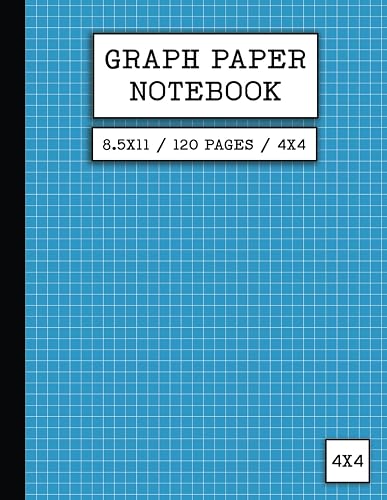
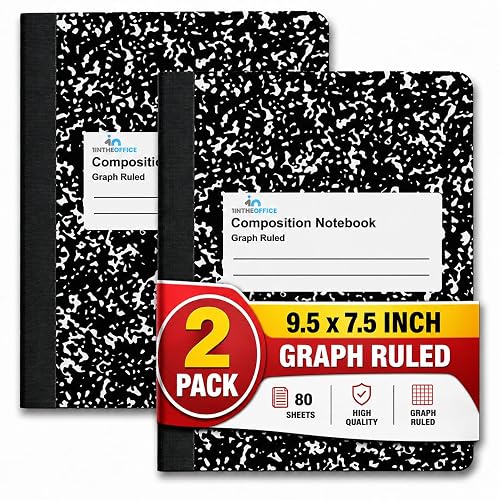
Current composition-book catalogues include quad-ruled and graph composition formats specifically positioned for graphing, calculations and organized technical notes. The grid can help keep columns, fractions, coordinate points and geometric shapes aligned without drawing guide lines by hand.
That advantage is strongest when the grid is actually used. If you ignore most of the squares, the extra lines can become visual clutter rather than support.
Check grid density before buying
“Graph ruled” and “quad ruled” are useful category labels, but the number and size of squares can vary by product. Some current composition books use five squares per inch, while other graph formats use different spacing.
If your class, teacher or assignment requires a specific grid, verify the exact specification. Do not assume every graph composition notebook is interchangeable.
Standard composition size works for many classes
Current graph composition books are available in the familiar roughly 7.5 by 9.75 inch school format, while larger letter-size graph books also exist. A standard composition size is easier to carry and store with other class books, while a larger page gives more room for multi-step problems, graphs and diagrams.
Choose the larger format only when the extra working area is genuinely useful; otherwise the added bulk may not help.
Page count should match the course structure
A math notebook can fill quickly when each problem needs several lines of working. Higher capacity is useful for a long course, but a thinner notebook can be easier to separate by unit, term or subject.
Check whether the listing counts sheets or pages. A product described as 100 sheets has twice as many writable sides when both sides are usable, but retailers may present capacity differently.
Cover and binding matter in a backpack
Math notebooks often travel daily between home, class and study spaces. Current graph composition options include traditional soft covers and poly-cover versions, with sewn or fixed bindings on several mainstream products.
A more durable cover is useful when the notebook will be carried for months. If it stays mainly on a desk, a basic cover can be sufficient and lighter.
When lined paper may still be better for math
Not every math course is graph-heavy. Proofs, definitions, theorem notes, exam corrections and written reasoning can read more naturally on lined pages. College ruling is efficient for compact notes, while wide ruling gives larger handwriting more room.
A lined composition notebook is therefore not “wrong” for math. It is simply better suited to text-first work than to coordinate graphs or highly aligned calculations.
Dual-format pages can be useful for mixed work
Some current composition products combine grid and ruled sections. These can work well when a class regularly moves between calculations and written explanation, but the split layout only helps if both areas are used often enough.
Before choosing a dual format, check how much of each page is given to the grid and how that matches the assignments you usually receive.
What to avoid
Math-specific shopping becomes confusing when “graph,” “quad,” “grid” and “composition” are treated as if they guarantee one standard page. Verify the physical layout before you buy.
- Do not assume every graph composition book has the same square size.
- Do not choose graph paper just because the subject is math if most of your work is prose.
- Do not ignore notebook dimensions when diagrams need more working room.
- Do not compare sheet and page counts as if they are always the same measure.
- Do not buy by cover design before confirming the required ruling.
Frequently asked questions
These questions focus on the page-layout choices that matter most when a composition notebook is being used for math.
Is graph paper better than lined paper for math?
It is better when you regularly need alignment for graphs, tables, coordinates or multi-column calculations. Lined paper can be more comfortable for text-heavy notes and written explanations.
Are graph ruled and quad ruled the same thing?
They are often used for grid-based paper, but exact square size and layout can vary. Check the product specification when grid density matters.
What size composition notebook is best for math?
A standard composition size is portable and works for many classes. A larger page can be useful when you need more room for graphs, diagrams or long multi-step problems.
Should I use college ruled for math?
It can work well for theorem notes, definitions and compact written work. If the class involves frequent graphing or spatial calculations, a graph-ruled composition notebook may be more useful.
Do I need a specific grid size for class?
Only if the teacher, course or assignment specifies one. Otherwise choose a grid that is easy to write in and gives enough room for the level of detail you need.
RELATED POST
