How to Choose a Composition Notebook for Lab Work
A composition notebook is suitable for lab work only when the course or laboratory instructions allow that format. Some courses explicitly require a bound composition notebook because fixed pages preserve the record, while others require a purpose-built lab notebook with additional specifications.
Check the requirement first, then compare binding, ruling, capacity and cover.


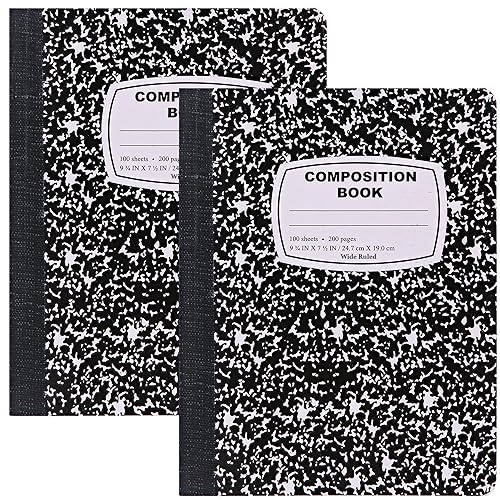

Start with the lab manual or syllabus
Laboratory notebook rules are course-specific. UCSC Biology laboratory materials instruct students to obtain a bound composition notebook for lab use, while chemistry requirements can also specify a bound composition-style notebook. Other laboratories may require pre-numbered pages, duplicate copies or a purpose-built laboratory book.
Do not buy from a generic recommendation before checking the exact course requirement.
Fixed pages are often the reason composition format is accepted
A bound composition notebook keeps pages in sequence and makes casual page removal less convenient than a perforated or loose-leaf system. Current Staples composition books include sewn, non-perforated construction in multiple rulings.
That page retention can support a chronological lab record, but it does not make every composition notebook acceptable for every laboratory.
Check perforation and binding separately
Current Staples wide- and college-ruled composition books specify sewn binding and non-perforated pages. Those details are more relevant to a lab-record requirement than the cover pattern.
If the course requires pages that cannot be removed without evidence, verify the exact notebook construction rather than relying only on the word composition.
Page numbering may be part of the setup
Some lab instructions require pages to be numbered before use or accept an ordinary bound composition notebook only when the student numbers the pages. That is a record-keeping rule, not a feature guaranteed by the notebook.
Follow the required setup exactly.
Choose ruling only after the course allows a choice
Lined pages can suit text-heavy observations and procedures, while graph or quad ruling can help with tables, plots and aligned calculations. Current laboratory requirements vary, including examples that specifically request quadrille books.
Do not choose graph ruling simply because the notebook will be used in a lab. The instructor’s requirement comes first.
Capacity should match the record length
Current fixed-bound composition books include 100-sheet examples in wide and college ruling. Higher capacity can keep a long course in one volume, but a laboratory may specify its own minimum or use separate books for notes and experiments.
Check whether a listing counts physical sheets or writable page sides before comparing capacity.
An ordinary composition book is not automatically a formal lab notebook
A standard school composition notebook does not automatically provide pre-numbered pages, duplicate copies, archival specifications, chemical resistance or any formal compliance standard. Those features must be verified separately when the laboratory requires them.
Use an ordinary composition notebook only when the course permits it and the exact construction satisfies the stated rules.
Cover construction is secondary
A rigid paperboard cover can add writing support and protect the page block, while other composition books use flexible covers. Cover type does not determine whether the notebook meets a lab-record requirement.
Choose cover durability after binding, page-retention and ruling requirements are satisfied.
What to avoid
The main mistake is assuming that any bound-looking notebook qualifies for laboratory records.
- Do not use an ordinary composition notebook when the course requires a purpose-built lab notebook.
- Do not substitute perforated or spiral pages when fixed pages are required.
- Do not assume every lab needs graph ruling.
- Do not call a standard composition book chemical-resistant or archival without evidence.
- Do not ignore page-numbering or setup instructions.
Frequently asked questions
These questions focus on when an ordinary composition notebook can satisfy a laboratory notebook requirement.
Can I use a composition notebook as a lab notebook?
Only when the course or laboratory permits it. Some courses explicitly require a bound composition notebook, while others require additional laboratory-notebook features.
Does a lab composition notebook need graph paper?
Not universally. Use graph or quadrille ruling only when the course requires it or the work benefits from repeated alignment.
Why do some labs require a bound notebook?
Fixed pages help preserve the sequence of the record and make page removal more evident than loose or easily removed sheets.
Does a composition notebook need numbered pages for lab work?
Some courses require page numbering. Follow the lab instructions; ordinary composition notebooks do not all come with pre-numbered pages.
RELATED POST
