Graph-Ruled Composition Notebooks: Choose the Right Grid
A graph-ruled composition notebook is most useful when alignment is part of the work. The important detail is the grid itself: current products use different square densities, so “graph” or “quad” is not a complete specification.
Check grid density first, then page size, capacity, cover and binding.


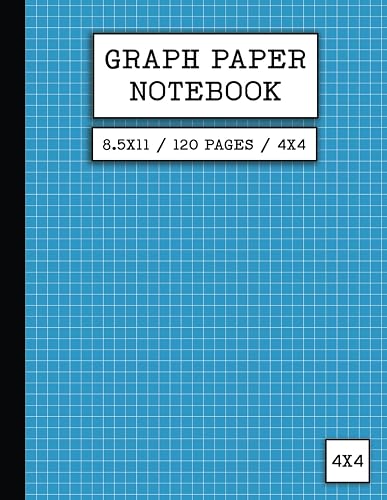
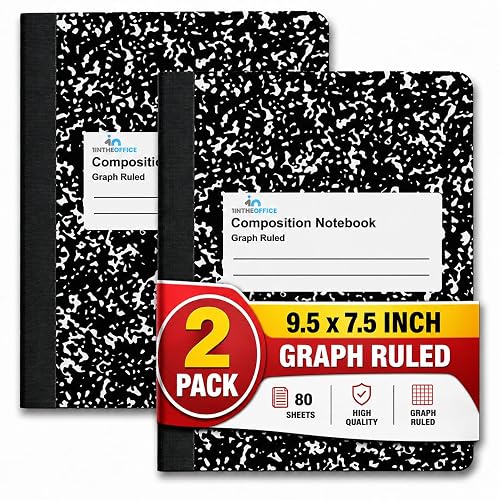


Graph and quad are category labels, not one universal grid
Retailers use both terms for squared paper, but exact geometry varies. Current Staples composition books use a 5-by-5 quadrille rule, meaning five squares per inch. Target also sells a reversible quad composition format with four squares per inch on one side and five on the other.
If an assignment or workflow needs a specific scale, verify the product rather than relying on the label.
Choose grid density around the marks you make
A denser grid gives more reference points for compact graphs, tables and calculations. A larger square gives handwriting, labels and sketches more room. Neither is inherently better.
Five squares per inch is common in current composition products, but it should not be treated as universal. A page preview is especially useful when you write inside individual squares.
Page size changes usable working area
Several current Staples graph composition books use the familiar 7.5 by 9.75 inch format. Target also carries a larger 8.5 by 11 inch reversible quad composition book. The larger page gives more room for diagrams and multi-column work but takes more bag and desk space.
Choose size after considering the scale of the work, not simply because a larger notebook looks more capable.
Capacity matters for long-running technical work
Current graph composition products include 80-sheet examples and other capacities. More sheets keep a longer project in one fixed record, while a thinner book can reduce bulk.
Always distinguish sheets from writable page sides when comparing listings.
Fixed binding is part of the composition format
Staples currently describes its graph composition books as center-sewn, with pages held in place for permanent note-taking. That makes the format useful when calculations, observations or diagrams should remain in sequence.
If pages must be removed frequently, a spiral or perforated format may be more practical.
Cover construction changes handling, not the grid
Current graph composition books include rigid casebound and flexible-cover options. A rigid cover can provide writing support away from a desk, while a flexible cover can reduce bulk.
Choose the cover for transport and handling; choose the ruling for the work itself.
When graph ruling is the right fit
Graph ruling adds value for coordinates, equations, tables, scale drawings, diagrams and any notes where vertical and horizontal alignment matter. It can also support structured layouts outside mathematics.
For long prose notes, the grid may add visual noise. In that case, wide or college ruling can be simpler.
What to avoid
Do not buy a graph composition book without checking the actual page.
- Do not assume every quad-ruled book has identical square size.
- Do not confuse spiral graph notebooks with fixed-bound composition books.
- Do not choose the densest grid if labels and handwriting become cramped.
- Do not compare page counts without checking whether the seller means sheets or sides.
Frequently asked questions
These questions focus on grid specifications that can change the buying decision.
Are graph ruled and quad ruled the same?
They are commonly used for squared paper, but the exact grid can vary by product. Verify square size when it matters.
What does 5 squares per inch mean?
It means each square is one fifth of an inch wide and high. Several current composition books use this density.
Is a larger graph composition notebook better?
Only when the extra working area helps. A standard composition size is easier to carry, while a larger page gives diagrams and tables more room.
Is graph ruling only for math?
No. It can help with science data, technical sketches, tables and other work where alignment matters.
RELATED POST
