Graph vs Lined Composition Notebooks: Which Should You Choose?
Choose a graph composition notebook when the page needs alignment in two directions; choose a lined composition notebook when most of the work is continuous handwriting. The ruling should match what you actually put on the page.
After that first decision, compare spacing, capacity, binding and cover instead of assuming the ruling tells you everything about the notebook.


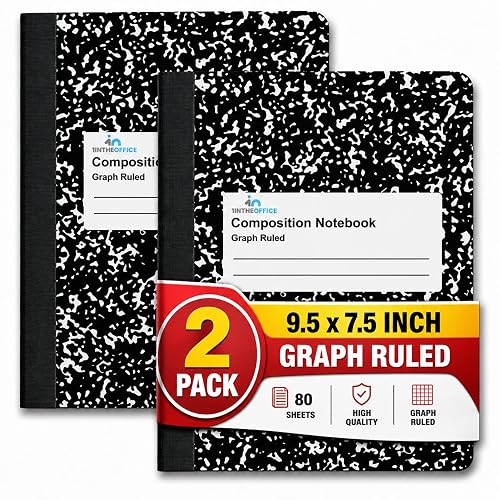


Graph or lined: the quick decision
Graph ruling gives you horizontal and vertical guides. That makes it useful for calculations, coordinate plots, tables, diagrams, technical sketches and notes where columns need to stay aligned. Lined ruling gives horizontal guides without the vertical grid, so paragraphs, lecture notes, reading responses and longer written explanations usually feel less visually constrained.
Neither format is universally better. The useful question is: what structure does the page need most often?
Choose graph ruling when alignment is part of the work
A graph composition notebook is the stronger default when numbers, shapes or data must line up repeatedly. Current Staples graph composition books include 5-squares-per-inch ruling, showing how grid density becomes a real product specification rather than a decorative feature.
For a deeper grid-only decision, see our graph-ruled composition notebook guide.
- Calculations: vertical guides can help keep digits and steps aligned.
- Graphs and coordinates: the grid provides repeatable reference points.
- Tables: rows and columns are easier to build consistently.
- Diagrams: squares can help with proportion and spacing.
Choose lined ruling when writing dominates
Horizontal ruling is usually the simpler surface for sentences, paragraphs and conventional class notes. You still need to choose the spacing. College ruling fits more lines on a page, while wide ruling gives larger handwriting more vertical room.
Compare our college-ruled composition notebook guide and wide-ruled composition notebook guide before treating all lined pages as equivalent.
What if your notes mix words and calculations?
Mixed work is where the decision becomes less obvious. A science or math page may contain equations, short explanations, tables and sketches together. In that case, graph ruling can provide a flexible framework if you do not mind writing prose over a visible grid. If most pages are text with only occasional calculations, lined ruling may remain easier to scan.
For mathematics specifically, use our composition notebook for math guide; course requirements should override a generic ruling preference.
Graph density matters
Do not stop at the word “graph.” Grid spacing changes how much information fits on the page and how comfortably you can write inside or across the squares. Current composition notebooks include 5-squares-per-inch graph ruling, while other products use different grid densities.
Choose a finer grid for compact plotting and detailed layouts only if your handwriting and task suit it. A larger grid can be easier for bigger writing or simpler diagrams.
Lined spacing matters too
“Lined” can mean wide, college or narrower ruling. If your writing is large, tighter lines can make notes cramped. If your writing is small and you need dense notes, wide ruling can waste useful page area.
This is why graph versus lined is only the first filter. The second filter is the actual spacing printed on the page.
Do not ignore capacity and binding
Two notebooks with the same ruling can behave differently in daily use. Current composition-book catalogues include different sheet counts, flexible and harder covers, sewn construction and other fixed-bound designs.
- Check whether the listing states sheets or pages.
- Choose enough capacity for the expected project or course.
- Verify the exact binding if page retention matters.
- Choose cover construction for the way the notebook will be carried.
Follow the class requirement first
If a teacher, syllabus or supply list specifies graph, quad, wide or college ruling, follow that requirement before applying a general preference. The same applies to requested sheet count, color or non-spiral construction.
Buying checklist
- Will most pages contain prose or two-axis layouts?
- If graph, what grid density is comfortable?
- If lined, do you need wide or college spacing?
- How many sheets are required?
- Does the binding need to keep pages permanently in sequence?
- Will a flexible or harder cover fit the carrying conditions?
- Does a school or course specify the format?
Bottom line
Graph ruling is a tool for alignment; lined ruling is a tool for continuous writing. Choose the page structure that solves the dominant task, then verify the notebook specifications independently.
Frequently asked questions
These answers focus on the ruling decision rather than assuming one page style works for every subject.
Is graph paper better than lined paper for math?
Graph ruling is often useful when calculations, coordinates, tables or diagrams need alignment, but a course may still require a lined notebook. Follow the class requirement first.
Can you take normal notes on graph paper?
Yes. Graph paper can hold ordinary handwriting, but the full grid is visually stronger than horizontal lines. Choose it for prose only if that extra structure helps rather than distracts you.
Is college ruled or wide ruled better for notes?
College ruling fits more lines on a page; wide ruling provides more vertical room for larger handwriting. The better option depends on handwriting size and the required note density.
Does graph ruling mean the notebook has better paper?
No. Ruling describes the printed page layout. Paper quality, binding, cover and capacity are separate specifications that must be checked on the exact product.
RELATED POST
