Dot Grid vs Graph Composition Notebook: Which Ruling Works Better?
Choose graph ruling when continuous square lines are part of the work; choose dot grid when you want alignment guides that fade into the background. Both formats can support lists, diagrams and structured notes, but they create different levels of visual control.
Start with the task, then verify spacing, size, capacity, cover and binding.


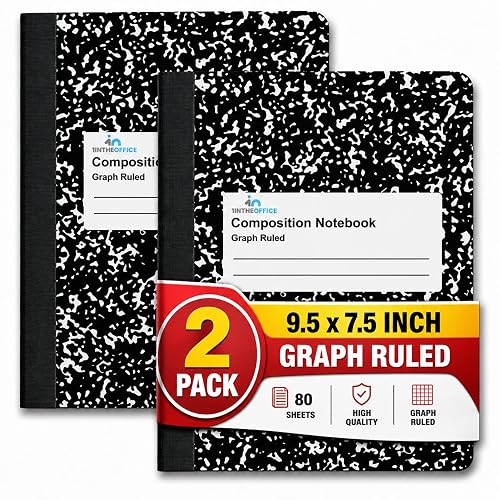


Dot grid vs graph composition notebook: the quick answer
Graph paper prints continuous horizontal and vertical lines, making every square immediately visible. Dot grid marks the intersections instead. The dots preserve alignment while leaving more white space between guides.
- Choose graph ruling for plotted data, equations, scale drawings and tables that depend on visible squares.
- Choose dot grid for mixed notes, flexible layouts, trackers and diagrams where a lighter guide is enough.
- Choose from actual spacing, not the ruling name alone.
Graph ruling provides stronger structure
A full grid helps keep numbers, columns and coordinates aligned across the page. A current Staples graph-ruled composition notebook, for example, specifies a 5 × 5 grid and positions it for plotting, graphing and organized writing.
That stronger structure can also make the page look busy when most of the content is prose. If you rarely use the vertical lines, a dot grid or lined page may be easier to scan.
Dot grid keeps the guides quieter
Dot-grid pages show regularly spaced points rather than full boxes. Current LEUCHTTURM1917 documentation lists dotted ruling with 5 × 5 mm spacing, while current US composition products from Target and Pen+Gear use dot-grid or dot-ruled pages in the familiar 7.5 × 9.75 inch format.
The dots can guide headings, indentation, boxes and simple diagrams without dominating the finished page. They are less explicit than graph lines, so precise plotting may require more effort.
Choose by what must stay aligned
The practical question is not which ruling looks cleaner. It is whether the page needs continuous references.
- Calculations and coordinate plots: graph ruling normally gives clearer row-and-column control.
- Tables and technical sketches: graph ruling makes dimensions and intersections easier to follow.
- Bullet-style notes and trackers: dot grid supports flexible blocks while remaining visually lighter.
- Mixed prose and diagrams: dot grid can reduce clutter, provided the writer is comfortable building lines from points.
Spacing changes the answer
“Graph” and “dot grid” do not guarantee one density. LEUCHTTURM1917 documents 5 × 5 mm squared and dotted rulings in its range. Staples describes a current graph composition book with a 5 × 5 grid, while product listings elsewhere may use squares per inch or a different spacing system.
Wider spacing gives handwriting and sketches more room. Denser spacing supports finer alignment but can feel cramped. Verify the unit because 5 mm spacing and five squares per inch are not the same.
Keep size and construction separate from ruling
Target currently lists dot-grid and quad-rule composition books with poly covers, 80 sheets and a 7.5 × 9.75 inch footprint. Pen+Gear also lists a dot-ruled poly composition book at that size, while Staples lists a center-sewn graph-ruled composition notebook. These examples show viable physical catalogues, but they do not make every dot or graph book identical.
Check whether the notebook uses sheets or page sides in its capacity claim, and verify whether the pages are sewn, glued or otherwise bound.
Use the foundational guides for the next decision
For the individual formats, compare our dot-grid composition notebook guide and graph-ruled composition notebook guide. If the choice is for calculations and plotted work, the composition notebook for math guide adds a subject-specific layer.
Buying checklist
Confirm the ruling and the physical notebook as separate parts of the decision.
- Will the page contain precise plots or mostly flexible notes?
- Are continuous grid lines useful or distracting?
- What is the exact dot or square spacing?
- Does the size give enough room for the intended layouts?
- Does the listing count sheets or writable sides?
- Will the cover and binding withstand the way the notebook is carried?
Bottom line
Graph ruling is the stronger technical guide; dot grid is the more visually flexible guide. Choose the amount of structure the work needs, then compare the remaining specifications on the exact composition notebook.
Frequently asked questions
These answers clarify where dots and continuous grid lines change the writing experience.
Is dot grid the same as graph paper?
No. Both provide horizontal and vertical reference points, but dot grid removes the continuous square lines. Exact spacing still varies by product.
Which ruling is better for math?
Graph ruling is usually clearer for calculations, coordinates and plots because the full grid remains visible. Dot grid can work for lighter diagrams but offers less continuous guidance.
Is dot grid better for journaling?
It can be when you want flexible layouts with less visual structure than graph paper. The better choice depends on how much alignment help you want to see.
Do dot-grid and graph composition notebooks use the same spacing?
Not necessarily. Current products include different grid systems, so verify the exact dot or square spacing rather than assuming the labels match.
RELATED POST
