Composition Notebook Sizes: Which Format Fits Your Use?
The best composition notebook size is the smallest format that still gives your handwriting, diagrams and notes enough room. Standard 7.5 × 9.75-inch books remain a practical middle ground, while mini and compact formats trade writing area for portability and B5 or 8.5 × 11-inch options give more usable space.
Do not choose by the size name alone. Compare the actual dimensions, ruling, sheet count and cover construction on the specific product.


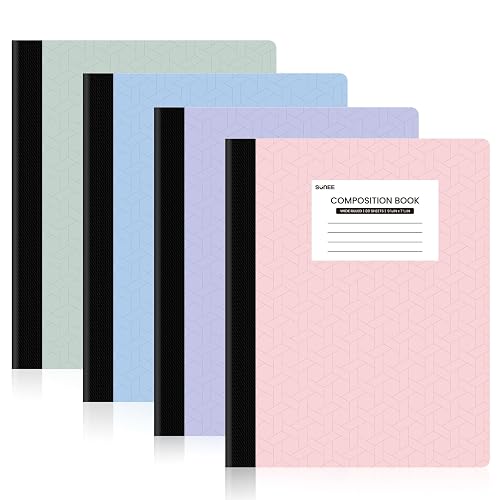


Start with what the notebook has to do
Size is useful only when it solves a physical problem. A smaller notebook is easier to carry; a larger one gives handwriting, tables and diagrams more room. The right choice depends on which constraint matters most.
- Go smaller when the notebook must fit a pocket, small bag or compact work kit.
- Stay near standard composition size for a balance of writing area, familiar handling and broad product availability.
- Go larger when diagrams, graphs, pasted material or large handwriting need more page space.
Use 7.5 × 9.75 inches as a useful reference point
Current US retail inventory still includes many physical composition notebooks around 7.5 × 9.75 inches. Quill, for example, lists Staples sewn composition books at that size in college-ruled and graph-ruled versions.
That makes the format a useful reference when comparing other sizes, but it is not a universal definition. Brands can trim composition books differently, so verify the dimensions of the exact notebook instead of assuming every “standard” model is identical.
Mini and small formats prioritize portability
Mini composition notebooks can be dramatically smaller than the familiar school book. Current Staples inventory includes a 3.25 × 4.5-inch mini composition book and 5 × 7-inch small composition books, all with fixed composition-style binding.
The gain is obvious: less bag space and easier on-the-go capture. The cost is narrower lines, shorter sentences per line and less room for tables or diagrams. Mini works best for quick notes, lists and portable reference rather than dense full-page coursework.
A5 is a compact full-page alternative
A5 sits between pocket formats and larger working notebooks. In practice it can provide a more conventional writing page than a true mini while still reducing the footprint in a bag.
Do not assume every seller uses the label consistently for composition products. If A5 is important because of a cover, folio or bag compartment, use the product’s stated millimetre or inch dimensions as the final check.
B5 gives more working room without jumping to letter size
B5 can be attractive when A5 feels cramped but a full 8.5 × 11-inch page feels excessive. LEUCHTTURM1917 currently specifies its Composition B5 format at 178 × 254 mm and offers it in hardcover and softcover configurations.
Again, the printed label is not enough. Other manufacturers may use slightly different B5 conventions or trim dimensions, so compare actual measurements when fit matters.
Large 8.5 × 11-inch formats favor working space
A larger composition format can make graphs, diagrams, tables and large handwriting easier to manage. Target currently lists an 8.5 × 11-inch quad-ruled composition notebook with 80 sheets, demonstrating that letter-size composition products exist alongside smaller school formats.
The trade-off is bulk. A larger page occupies more desk and bag space, and it does not automatically improve note quality if the ruling is wrong for the task.
Size and ruling should be chosen together
A small notebook with tight college ruling behaves very differently from a large quad-ruled book. Treat size as one axis and ruling as another.
- For compact text notes, smaller pages can work if your handwriting stays comfortable on the chosen ruling.
- For equations and plotting, graph or quad ruling can matter more than raw page dimensions.
- For large handwriting, more page area does not help much if the line spacing still feels cramped.
- For mixed diagrams and prose, prioritize usable page width and a ruling that does not constrain sketches.
Sheet count changes bulk as well as capacity
Two notebooks with similar dimensions can feel different in the hand because of sheet count, paper stock and cover construction. Current examples in the size spectrum include 80-sheet mini, standard and large composition books, while other composition formats may use different capacities.
Check whether a listing reports sheets or writable page sides before comparing capacity. A size decision should not quietly become a thickness decision because two products use different counting conventions.
Check actual dimensions when accessories must fit
Nominal labels are not precise enough when the notebook has to fit a cover, sleeve, organizer or fixed bag pocket. Use the manufacturer or retailer’s actual width and height, then allow for the cover and binding rather than comparing paper labels alone.
This is especially important across US composition sizes, A-series labels and B-series labels, which come from different naming traditions.
A practical size decision
If you are unsure, start from the familiar standard composition footprint and move only when a concrete need justifies it. Move down for portability; choose a compact A5-style footprint when you still want a full writing page; move toward B5 for more working room; and consider 8.5 × 11 inches when diagrams or large-format work genuinely benefit from the extra area.
Then verify ruling, sheet count, binding and cover on the exact product. Those checks prevent a theoretically correct size from becoming the wrong notebook in daily use.
Frequently asked questions
These questions focus on the size differences that can change the purchase decision.
What is a common standard composition notebook size?
A familiar US school composition format is about 7.5 × 9.75 inches. Current Quill listings show physical Staples composition notebooks at that size, but not every composition notebook uses identical dimensions.
Is a B5 composition notebook the same size as a standard US composition book?
No. Size labels and actual measurements should be checked separately. LEUCHTTURM1917, for example, specifies its Composition B5 at 178 × 254 mm, while common US school composition books are often listed around 7.5 × 9.75 inches.
When does a mini composition notebook make sense?
Mini formats make sense when carry convenience is more important than maximum writing area. Current Staples composition books include 3.25 × 4.5-inch and 5 × 7-inch options, showing how much the term “mini” can vary.
Is a larger composition notebook always better for diagrams?
No. More page area can help, but ruling matters too. A larger graph or quad-ruled page may suit charts and diagrams better than a larger lined page, depending on the work.
RELATED POST
