Roaring Spring Composition Notebooks: How to Choose the Right Type
Choose a Roaring Spring composition notebook by its physical configuration, not by the logo alone. The current range spans college, wide, primary, graph and unruled pages, along with different sizes, capacities and cover constructions.
Start with the page layout your work requires, then verify size, binding and quantity on the exact item.


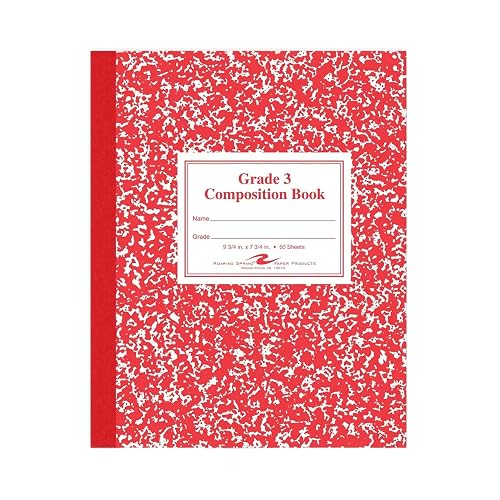


Quick selector
The fastest route is to match the ruling to the work and then remove models that fail the size or construction requirement.
- Choose college ruled for compact handwriting and dense conventional notes.
- Choose wide ruled for larger handwriting or a roomier line.
- Choose graph ruled for calculations, tables, plotting and aligned diagrams.
- Choose unruled for sketches and layouts that should not follow printed guides.
- Choose primary writing layouts when a learner needs age-appropriate handwriting guides.
Choose the ruling before the collection
Roaring Spring’s current catalogue includes standard, Signature Collection and other composition formats, but a premium label cannot correct the wrong page layout.
Use the college-ruled guide when writing density is the decision, the wide-ruled guide when line spacing must be more generous, and the graph-ruled guide when the grid carries information.
Standard, oversized and premium formats solve different jobs
The current catalogue includes traditional-size books, oversized flexible-cover books and Signature Collection oversized hard-cover books. A larger footprint creates more working area, while a rigid cover provides more support away from a desk.
Do not assume every item called oversized has the same dimensions. Compare the stated measurements with the bag, desk and handouts you actually use.
Hard board and flexible covers change the carrying experience
Blick currently describes a 9.75 by 7.5 inch hard-board model with center-sewn, tape-bound pages that are not intended for removal. Other current listings use flexible covers or different dimensions.
Choose hard board when surface support and edge protection matter. Choose flexible construction when reduced bulk and easier packing matter more. Cover material does not establish ruling or paper quality.
Capacity varies across the range
Current retailer listings show multiple capacities rather than one brand standard. Office Depot lists 48-, 50- and 60-sheet models, while the wider catalogue includes 70-, 80- and 100-sheet configurations.
Match capacity to the expected duration of the class or project. A thinner book is easier to carry; a higher-capacity book reduces the risk of splitting one subject across volumes.
Keep sheets and pages separate
Blick describes one model as 100 pages, while Office Depot identifies another as 50 sheets and 100 pages. That relationship is logical when both sides are counted, but retailer terminology is not universally consistent.
Compare like with like. If a listing gives only pages, do not silently treat that number as sheets.
Primary, recycled and unruled options need their own checks
Early-writing layouts should be matched to the teacher’s requested ruling. Recycled models should be chosen on a stated material claim, not a green cover. For visual work, compare an unruled composition notebook with the exact paper and binding requirements.
Single books and case quantities are different decisions
Some current results are individual books, while others are cases intended for classrooms. A low unit price does not help if the package quantity is unsuitable.
Verify whether the listing is one book, a multipack or a full case, and confirm that all books share the required ruling and capacity.
Specification checklist
Use the product page, not the thumbnail, to confirm every attribute that affects the job.
- Ruling or page layout
- Exact dimensions
- Sheets versus pages
- Hard board or flexible cover
- Binding and whether pages stay fixed
- Paper weight when stated
- Single-book, pack or case quantity
What to avoid
Brand familiarity is useful only after the physical specification is clear.
- Do not assume every model is the traditional 9.75 by 7.5 inch size.
- Do not treat college, wide and graph ruling as interchangeable.
- Do not convert pages to sheets without source support.
- Do not mistake a wirebound product for a fixed-bound composition book.
- Do not buy a classroom case when you need one notebook.
Frequently asked questions
These answers clarify the specifications that most often separate Roaring Spring composition books.
Does every Roaring Spring composition book have the same number of sheets?
No. Current catalogues show different capacities, including 48-, 50-, 60-, 70-, 80- and 100-sheet configurations. Verify the exact item rather than relying on the brand name.
Are Roaring Spring composition books available with blank pages?
Yes. Current catalogues include unruled models as well as college-, wide-, primary- and graph-ruled options.
What is the difference between a sheet and a page?
A sheet has two writable sides, but retailers do not always use the terms consistently. Read the product specification and do not convert automatically.
Should I choose a hard or flexible cover?
Choose a hard board cover for more writing support and a flexible cover for lower bulk. Also check dimensions, because cover type and size can change together.
RELATED POST
