A4 vs Letter-Size Composition Notebook: Which Format Fits Your Work?
Choose A4 when you need the international paper standard and extra page height; choose US Letter when North American handouts, folders and filing systems set the format. The sizes are close, but they are not interchangeable.
Compare the actual notebook dimensions, usable writing area, ruling and binding before buying.



A4 vs Letter composition notebook: quick answer
A4 measures 210 × 297 mm, approximately 8.27 × 11.69 inches. US Letter measures 8.5 × 11 inches, or 215.9 × 279.4 mm. Letter is about 5.9 mm wider; A4 is about 17.6 mm taller.
- Choose A4 for ISO-based schools, offices and filing systems.
- Choose Letter for US and Canadian handouts, folders and printer-paper compatibility.
- Verify the listing because “large” and “full size” are not precise standards.
The shape difference changes the writing area
A4 provides more height, which can allow longer vertical notes, additional rows or taller diagrams. Letter provides slightly more width, which can help with tables, equations or annotations across the page.
Cover size does not equal usable writing area. Margins, ruling and the inner gutter reduce the space available to the pen. Compare page previews as well as nominal dimensions.
Match the surrounding paper system
The most practical choice often comes from the documents used around the notebook. Letter-size composition books integrate more naturally with US classroom handouts and office printouts. A4 fits the standard paper ecosystem used across much of the rest of the world.
If printed sheets must be pasted into the notebook, test one sheet first. A4 and Letter overlap imperfectly: A4 is taller, while Letter is wider.
Do not confuse Letter with standard US composition size
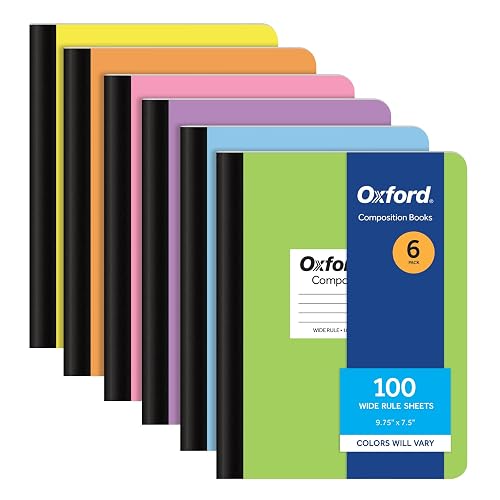
A classic US composition notebook is commonly around 7.5 × 9.75 inches, which is smaller than both A4 and Letter. A listing called “standard composition book” may therefore describe the traditional school format rather than full-size Letter.
Use our composition notebook size guide to place traditional, A5, B5, A4 and large formats in one system.
A4 favors international compatibility
A4 composition notebooks are the safer choice when course packets, office documents, folders or shelves are designed around ISO paper. Its extra height also gives room for long outlines and vertically arranged diagrams.
The trade-off is portability. An A4 composition book occupies more bag height than a traditional composition notebook and may extend beyond storage designed around smaller school books.
Letter favors North American compatibility
Letter-size and other large composition notebooks align with the 8.5 × 11 inch paper common in US and Canadian classrooms and offices. This can simplify worksheets, reference sheets and document storage.
A Letter notebook is slightly wider and shorter than A4. It may be preferable for broad tables or landscape-like page layouts, but the exact ruling can matter more than the small width advantage.
Ruling can outweigh the size difference
A large page with unsuitable ruling remains a poor choice. College ruling fits denser text, wide ruling supports larger handwriting, and graph ruling helps with calculations and diagrams.
Check the line or grid spacing on the exact product. Do not assume all A4 books use metric ruling or all Letter books use college ruling.
Compare capacity without mixing sheets and pages
A4 and Letter composition notebooks can use very different sheet counts. A listing may also describe writable sides as pages. One hundred sheets can provide two hundred writable sides when both sides are intended for use, but retailer terminology varies.
Record the stated sheet count and consider total bulk. More page area multiplied by more sheets can create a heavy book.
Binding and opening behavior affect large pages
A sewn or fixed binding supports a permanent sequence, while the wide page spread can increase pressure near the gutter. A book that opens well is easier to use across the full writing area.
Compare our lay-flat composition notebook guide if two-column notes, diagrams or left-page writing require easy access near the center.
Portability and storage checks
Measure the environment, not just the notebook. Check backpack height, shelf depth, desk space and any folder or cover intended to hold the book.
- Will the notebook travel every day?
- Must it fit an A4 or Letter folder?
- Will printed handouts be attached?
- Does the desk support a full open spread?
- Is extra page height or width genuinely useful?
Buying checklist
Use exact measurements and workflow compatibility to make the final choice.
- Confirm A4 as 210 × 297 mm or Letter as 8.5 × 11 inches.
- Check whether dimensions describe the cover or inside sheets.
- Verify ruling and margin layout.
- Compare sheet count without assuming page terminology.
- Check binding and flat-opening behavior.
- Match folders, handouts, shelves and bags.
- Do not treat “large” as a standardized size.
Bottom line
A4 is taller and globally compatible; Letter is wider and fits North American paper systems. Let institutional requirements and surrounding documents decide first, then compare ruling, capacity and binding.
Frequently asked questions
These answers focus on the practical differences between A4 and US Letter-size composition notebooks.
Is A4 the same size as Letter?
No. A4 is 210 × 297 mm, while US Letter is 8.5 × 11 inches or 215.9 × 279.4 mm. A4 is narrower and taller.
Which size is better for US school handouts?
Letter generally matches US classroom printouts more closely. Follow the school requirement and verify the notebook’s actual dimensions.
Which size gives more vertical writing space?
A4 is about 17.6 mm taller than Letter. Usable space still depends on margins, ruling and the binding gutter.
Will an A4 notebook fit a Letter-size folder?
Not necessarily. A4 is taller, so check the folder, shelf and bag dimensions rather than treating the formats as interchangeable.
RELATED POST
