70-Sheet Composition Notebooks: When Lower Capacity Works
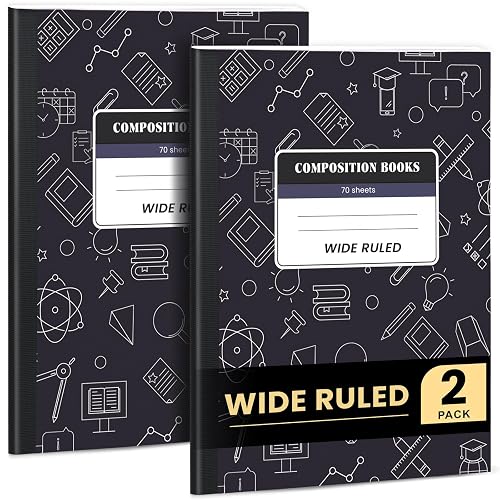
A 70-sheet composition notebook makes sense when you want enough room for a focused class or project without automatically carrying a thicker book. Current physical products include 70-sheet wide- and college-ruled composition books with sewn binding, so capacity does not decide the page format.
Check any required count first. If capacity is open, compare 70 with 80 and 100 sheets around the amount of writing you realistically expect.




Start by checking whether 70 sheets are allowed
A teacher, course or project can specify a minimum notebook capacity. When it does, follow that requirement before trying to reduce bulk. If no count is specified, 70 sheets become a workload decision rather than a compliance decision.
Separate sheets from pages before comparing
A sheet is one physical leaf with two sides. Retailer wording can be inconsistent, so compare the exact specification rather than assuming that a 70-page and a 70-sheet product offer the same writing capacity.
Seventy sheets can fit a focused workload
A lower-capacity composition book can work well for a shorter course, one project, a light-note subject or a notebook that you expect to replace by term. The advantage is not that 70 is inherently better; it is avoiding capacity you are unlikely to use.
If you routinely fill a notebook before the class or project ends, a larger count is the safer choice.
Compare 70 with 80 and 100 sheets by expected writing volume
The difference is straightforward: 80 sheets add ten physical leaves and 100 sheets add thirty compared with a 70-sheet book. Those extra sheets are useful only when they prevent an inconvenient notebook change.
- Choose 70 sheets when the workload is modest and predictable.
- Choose 80 sheets when you want a little more buffer without moving directly to 100.
- Choose 100 sheets when one continuous volume is likely to be filled over a long class or project.
Capacity does not choose the ruling
Target currently lists separate 70-sheet composition books in wide and college ruling. Wide ruling gives larger handwriting more vertical room, while college ruling fits denser text. Choose the ruling for the writing task first.
Do not substitute a spiral notebook simply because it also has 70 sheets. Binding changes the workflow and the current page is specifically about composition notebooks.
Cover and binding remain separate decisions
Current up&up 70-sheet composition products use flexible poly covers and sewn binding, while Staples lists other sewn 70-sheet composition books. Those examples show that fixed binding is available at this capacity, but construction must still be verified product by product.
A poly cover can reduce rigidity for daily carrying, while a harder cover can provide more writing support. Neither cover type changes the sheet count or ruling.
Lower capacity can reduce unused paper, not guarantee a lighter book
All else being equal, fewer sheets mean less paper. Real notebooks also differ in paper weight, cover material, dimensions and binding, so a 70-sheet book is not automatically lighter than every 80- or 100-sheet alternative.
Use capacity to reduce unnecessary pages, then check the full product when portability matters.
When 70 sheets are not enough
Move up in capacity when the class explicitly requires it, when you take extensive handwritten notes, or when keeping one continuous record matters more than minimizing thickness. A 100-sheet book can be more convenient than switching notebooks near the end of a term.
What to avoid
Capacity is useful only when it matches the workload.
- Do not substitute 70 sheets when a class requires 80 or 100.
- Do not confuse sheets with writable page sides.
- Do not count spiral notebooks as composition-notebook alternatives.
- Do not assume every 70-sheet book has the same ruling, cover or binding.
- Do not infer paper quality from sheet count.
Frequently asked questions
These questions focus on whether 70 sheets provide enough capacity for the intended workload.
Is a 70-sheet composition notebook enough for school?
It can be when the class does not specify a higher count and the expected handwritten workload is moderate. Follow any current teacher requirement first.
How many pages are in a 70-sheet composition notebook?
A 70-sheet book contains 70 physical leaves with two sides each. Retailers may describe page counts differently, so verify the exact listing.
Do 70-sheet composition notebooks come in different rulings?
Yes. Current physical products include both wide-ruled and college-ruled 70-sheet composition books.
Is 70 sheets better than 80 or 100?
No capacity is universally better. Choose 70 when it comfortably covers the workload; choose more sheets when continuity or a class requirement makes the extra capacity useful.
RELATED POST
