Composition Book or Spiral Notebook? Choose by How You Work
The practical difference between a composition book and a spiral notebook is not the cover style—it is what the binding lets you do with the pages. A composition notebook is a stronger fit when you want one continuous record that stays together, while a spiral notebook can be more convenient when removing or rearranging individual sheets is part of the workflow.
Choose between permanence and page flexibility first, then compare ruling, capacity, cover and size.
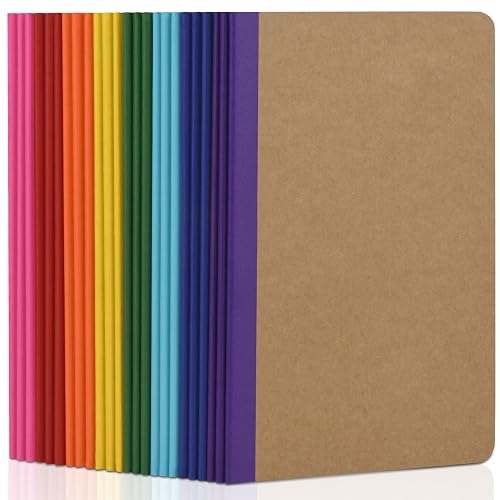


Start with one question: should the pages stay together?
This is the cleanest way to separate the two formats. Current Mead composition books use a fixed sewn binding and non-perforated pages, while current Mead spiral notebooks use wire binding and include perforated sheets on several models. Those are specific product examples, but they illustrate the basic decision well.
If the notebook is meant to become a chronological record of a class, project, journal or set of observations, a composition book keeps the structure simple. If individual sheets regularly need to be handed in, moved to a binder or removed cleanly, a spiral format may be more convenient.
Composition notebooks favor page security and continuity
Fixed pages make a composition book useful when losing or rearranging sheets would undermine the value of the notebook. Mead’s current college-ruled composition book, for example, uses sewn binding, has no perforated sheets and is positioned for journaling and lab notes as well as class work.
That structure works especially well for long-running notes, reflective writing and records that make more sense in sequence. You do not need to manage a coil or decide which pages should be removed.
Spiral notebooks make individual pages easier to manage
Current Mead spiral notebooks show a different design logic: wire binding, perforated sheets and, on some models, three-hole punching for binder storage. That can be useful when worksheets, assignments or notes need to leave the notebook regularly.
The trade-off is that easy removal is only an advantage if you actually need it. If your goal is to preserve one complete notebook, perforated pages and binder compatibility may add little value.
Writing access depends on the exact binding
It is often said that spiral notebooks always lie flatter and composition books do not, but that is too broad. Mead explicitly states that its current sewn composition book lays flat when open, while wirebound notebooks naturally allow pages to turn around the binding differently.
What matters is how you write near the centre or edge. If a coil bothers your hand, especially on the binding side, a smooth composition spine may feel cleaner. If you like folding the used side behind the notebook, wire binding can be more convenient. Check the exact construction rather than relying on the category name alone.
Think about how the notebook behaves in a bag
A composition book has an enclosed spine with no exposed wire, which can make stacking and shelving straightforward. A spiral notebook has a coil or wire edge that changes how the notebook sits beside other books and can be more vulnerable to bending if handled roughly.
Cover construction still matters within both categories. A rigid composition cover, flexible board and poly cover will not behave the same way, so choose the full product rather than assuming the binding decides durability by itself.
Composition books are strong for archiving
If you keep completed notebooks, a fixed spine and pages that remain in sequence can make composition books easier to treat as finished volumes. This is useful for journals, class records, project histories and any workflow where the completed book is valuable as a whole.
A spiral notebook can also be archived, but its removable-page features are less important in that scenario. The composition format is usually the simpler choice when permanence is part of the reason you are writing.
Ruling is a separate decision from binding
Do not assume composition means one page style and spiral means another. Both formats are sold with college ruling, wide ruling and graph layouts. The correct ruling still depends on handwriting and subject needs.
If you decide that a composition notebook fits the workflow, then move to the next decision: college ruled for denser notes, wide ruled for more vertical writing space, graph or quad for aligned calculations, or primary ruling when beginning handwriting guidance is required.
Capacity and size can change the result
Current Mead examples show that composition and spiral notebooks can differ in sheet count and physical dimensions, but those specifications vary widely by product. Do not compare the formats using one pair of models as if the dimensions were universal.
Instead, decide how much continuity you need and how large a notebook you are willing to carry. Then compare actual page or sheet counts and remember that retailers may describe sheets and writable sides differently.
When the composition book is the better choice
A composition notebook makes the strongest case when you value continuity more than removable pages. That can include school notes that must stay together, a personal journal, a project record or a notebook you plan to keep after it is filled.
- Choose composition when page retention and chronological order matter.
- Choose composition when you prefer a smooth enclosed spine without an exposed coil.
- Choose composition when the notebook itself will be archived as a finished record.
When a spiral notebook may be more practical
A spiral notebook can be the better tool when individual-sheet flexibility is central. If pages need to be submitted, transferred to a binder or removed frequently, perforation and wire binding can make the workflow easier.
That does not make spiral objectively better for school or work. It simply solves a different page-management problem.
What to avoid
The comparison becomes misleading when one product example is treated as a universal specification for the whole category.
- Do not assume every composition notebook uses the same binding.
- Do not assume every spiral notebook has perforated pages.
- Do not claim one format always has better paper.
- Do not choose by binding before checking the ruling you need.
- Do not pay for removable-page features if your real goal is a permanent record.
If composition wins, choose the inside format next
Once you know that fixed pages and continuity fit your workflow, the remaining decision is about the composition notebook itself. Match ruling to handwriting or subject, capacity to the length of use, and cover construction to how often the book travels.
That second step is where a generic format comparison becomes an actual purchase decision.
Frequently asked questions
These questions focus on the structural differences that usually decide whether a composition book or spiral notebook is more practical.
Is a composition book better than a spiral notebook?
It is better when you want pages to remain together as one continuous record. A spiral notebook may be more practical when removing or transferring individual sheets is important.
Do composition notebooks lie flat?
Some do. For example, Mead states that its current sewn composition book lays flat when open. Check the exact binding rather than assuming every composition notebook behaves identically.
Are spiral notebook pages easier to remove?
Many spiral products use perforated sheets, including current Mead models, but this is product-specific. Verify perforation if clean page removal matters.
Which is better for journaling?
A composition notebook is a strong fit when you want a continuous journal whose pages stay in sequence. Choose the ruling and paper characteristics separately for your writing style.
Which is better for school notes?
It depends on the class. Composition books suit notes that should remain together, while spiral notebooks are convenient when assignments or pages need to be removed. Teacher requirements should take priority.
RELATED POST
